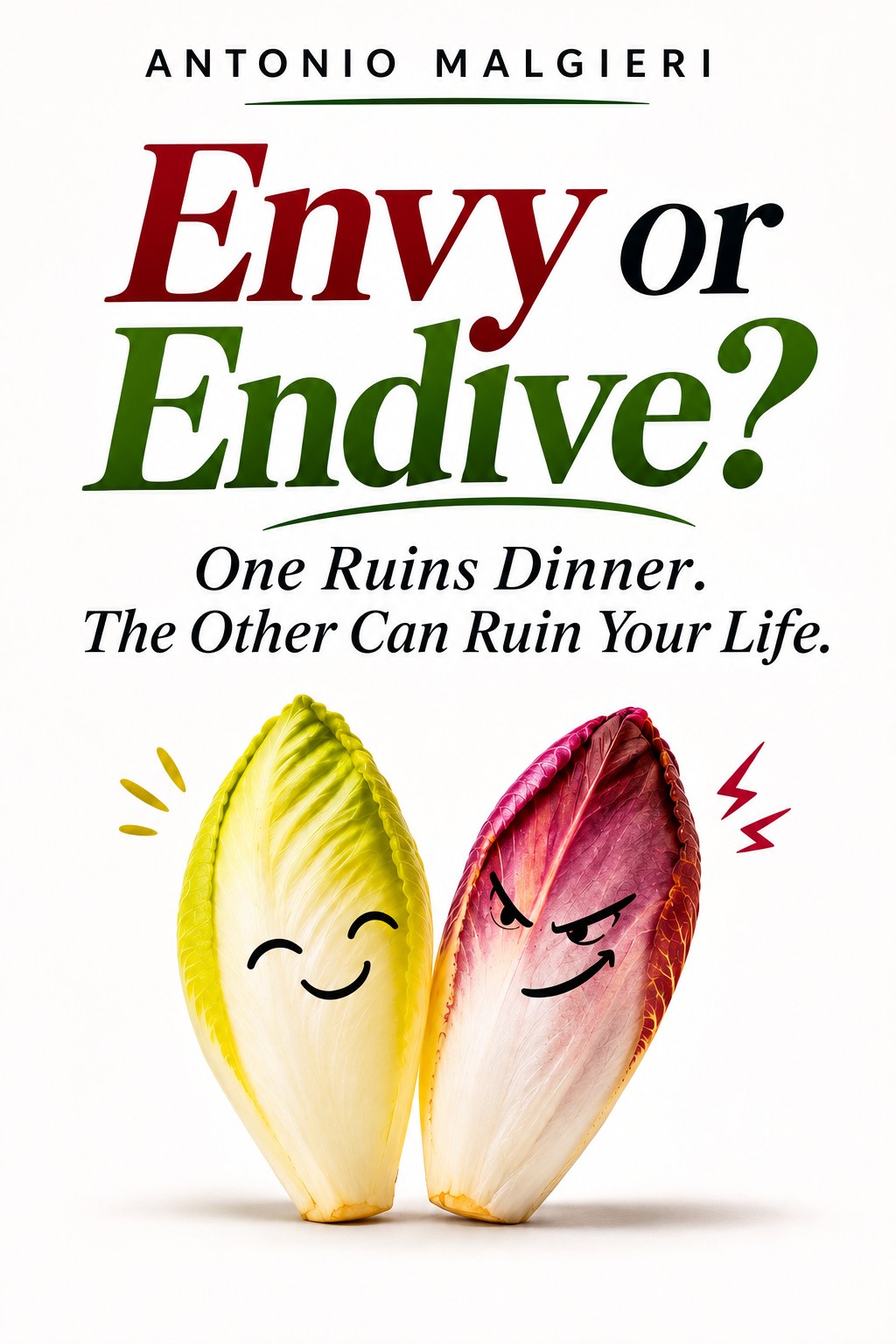
Envy or Endive?
One Ruins Dinner. The Other Can Ruin Your Life.
A book about envy, relationships, and the things we would rather not see in ourselves.
This book is not yet available for purchase.
 COMING SOON
Why is it sometimes so hard to celebrate someone else’s happiness?
The feeling we prefer not to name
There is an emotion we recognise instantly in other people and rarely admit in ourselves. We give it more flattering names: disappointment, fairness, healthy criticism. Yet envy is uncomfortable precisely because it says something not only about what we want, but about how we respond to another person’s happiness.
Sometimes we do not even want what someone else possesses. What unsettles us is their courage, their recognition, or the simple fact that life has opened a door for them. The question behind this book is deceptively simple: how free are we to celebrate someone else’s good fortune?
Why begin with a smile?
Envy and endive make an unlikely pair. One may leave a bitter taste at dinner; the other can leave bitterness in a relationship. The wordplay is an invitation to smile, not a way of making light of the subject. Humour lets us approach a difficult truth without immediately reaching for a defence.
We laugh at a small act of pettiness and then wonder, perhaps uncomfortably, whether we have ever done something similar. It is not a verdict. It is a mirror. And a mirror need not be cruel to be revealing.

Words may make us smile. Relationships ask for something more.
The people closest to us
We tend to imagine envy in the obvious places: competitions, promotions, money and public recognition. But human relationships are less orderly. We can feel diminished even in places where we expect only affection. Being close to someone does not automatically make their success easy to share.
That requires care in how we judge others. Not every hurtful remark is born of envy, and not every criticism conceals resentment. The book invites us to look more closely at our reactions, without pretending to know the secret motives of everyone around us.
When comparison takes over
Comparison can inspire us. Another person’s achievements may show us what is possible. But it can also become a kind of private bookkeeping: who was noticed, who received more, who deserved what. Gradually, someone else’s life occupies more space in our mind than our own.
The question changes from ‘What can I learn?’ to ‘Why them and not me?’ It is a human question, sometimes a painful one, but it rarely leads us towards the life we want to live. We may miss our own opportunities while counting somebody else’s.
No villains, no easy absolution
It would be convenient to divide the world into the envious and the envied, the innocent and the guilty. Human feelings are not so tidy. We may be generous one day and petty the next, genuinely happy for a friend and still feel a pang we cannot explain.
*Envy or Endive?* offers no recipe for fixing other people. It offers a more interesting possibility: looking at ourselves and our relationships with greater honesty. Lightness where possible, seriousness where necessary. A title may make us smile; what lies behind it deserves understanding.